
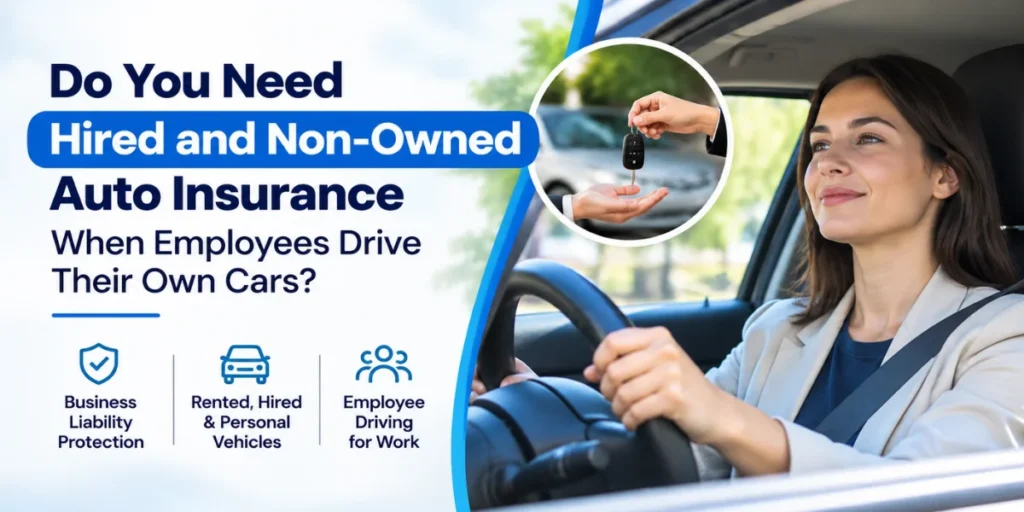
Your office manager offers to pick up supplies on the way back from lunch. A salesperson drives to a customer meeting. An employee uses a personal SUV to deliver an order.
None of those vehicles belongs to your company. Could an accident still become your company’s problem?
Yes, depending on the circumstances.
Hired and non-owned auto insurance can help protect a business against certain liability claims involving rented, hired or employee-owned vehicles used for work. It is worth reviewing even when your business owns no vehicles.
The important questions are who is driving, why they are driving, and whether the policy covers that exposure.
What Is Hired and Non-Owned Auto Insurance?
Often shortened to HNOA, the term brings together two related types of business auto liability coverage.
Hired auto insurance
Hired auto insurance generally addresses qualifying vehicles your business rents, hires, leases or borrows for business purposes.
A rented van used to move equipment to a trade show is a common example. The contract determines which arrangements qualify.
Non-owned auto liability
Non-owned auto liability generally addresses the business’s exposure when employees or other eligible people use vehicles the business does not own for company activities.
For example, an employee might drive a personal car to a client appointment.
Travelers explains that work-related use of rented or personal vehicles can expose a business to claims, and that commercial auto coverage does not automatically include every vehicle the company does not own.
Important distinction: HNOA is primarily a liability solution. It does not automatically provide comprehensive or collision coverage for the car being driven.
How Can an Employee’s Accident Involve the Business?
Vehicle ownership and legal responsibility are different questions.
If an employee causes an accident while performing work, an injured person may seek compensation from both the driver and the employer. Whether the business is legally responsible depends on the facts and applicable state law.
The Hartford identifies non-owned auto coverage as relevant when employees drive their own cars while working, even when that driving is infrequent.
Consider this hypothetical situation:
A small accounting firm sends an employee to deliver documents. The employee causes a collision that injures another driver. The claim names both the employee and the firm.
The owner’s statement—“We don’t own any company cars”—does not answer whether the firm has insurance for its alleged responsibility.
Reviewing commercial auto insurance coverage should include these less obvious driving arrangements.
Which Everyday Trips Deserve a Coverage Review?
Start with the activities employees actually perform.
| Activity | Exposure to discuss |
| Employee drives a personal car to meet a client | Non-owned auto liability |
| Staff member picks up supplies for the office | Non-owned auto liability |
| Business rents a van for an event | Hired auto liability and separate physical damage needs |
| Employee rents a car in their own name for a work trip | Rental arrangements and employee hired-auto provisions |
| Company purchases a delivery van | Coverage for the company-owned vehicle |
| Employee drives between home and their usual workplace | Commuting circumstances and any work-related exceptions |
These are review prompts, not coverage determinations.
A quick errand still deserves attention. The trip does not have to involve a delivery department or a fleet manager to create exposure.
Doesn’t the Employee’s Personal Auto Insurance Cover It?
It may provide some coverage, but you should not assume it protects everyone involved.
The Insurance Information Institute explains that personal auto policies can cover some business use, depending on the activity and policy. Other uses may require different coverage or be unacceptable to the insurer. Personal limits may also be insufficient for the business’s exposure.
Occasional travel to a meeting and frequent delivery work can present very different risks.
Employees should describe their driving accurately to their personal insurer. Your business should separately confirm its protection.
Practical tip: A current insurance card confirms a policy exists. It does not establish that the policy covers the employee’s particular work activities or your company’s liability.
What Can HNOA Cover—and What Does It Leave Out?
Depending on the form, HNOA can address covered third-party bodily injury or property damage claims and associated legal defense.
However, liability coverage is different from protection for every loss arising from an accident.
Progressive Commercial identifies important limitations, including damage to the hired or employee-owned vehicle, employee injuries and certain property in the business’s care. These may require other coverage.
Before an accident, get clear answers to three separate questions:
- Who protects the business if it is sued?
- Who repairs the employee’s car?
- Which coverage addresses the employee’s injuries?
One endorsement should not be assumed to solve all three.
Does HNOA Protect the Employee Personally?
Do not assume the driver is automatically insured for every claim simply because the business has HNOA.
The named insured, policy definitions and endorsements determine who receives protection.
Ask the advisor to explain coverage for:
- The business entity.
- Employees driving their own cars.
- Owners and partners.
- Volunteers or temporary workers.
- Employees renting vehicles in their own names.
Rental arrangements deserve particular attention. Travelers lists employee hired-auto coverage as an additional option for employees who rent vehicles in their own names while on company business. That illustrates why the name on the rental agreement matters.
What Happens First After an Accident?
Non-owned auto liability often operates above applicable personal auto coverage, but the actual order depends on the policies and circumstances. The Hartford describes non-owned coverage as providing additional liability protection over an employee’s personal coverage.
Do not interpret that as a promise that the employee’s insurer always pays first—or that a personal-policy denial automatically triggers payment by your business insurer.
Report the incident promptly to the potentially involved insurers. Preserve the trip purpose, driver information, photographs and any police report.
Let the insurers evaluate their obligations under the contracts.
A Business Owners Policy May Need an Endorsement
A business owners policy, or BOP, should not be assumed to include HNOA simply because it provides general liability protection.
Some insurers offer hired and non-owned liability through an endorsement. Travelers also distinguishes hired-auto liability from hired physical damage coverage, which can address eligible damage to rented vehicles.
Ask to see the actual endorsement, covered activities and limits.
If your company is adding employees, rentals or delivery services, review those changes alongside your growing business’s insurance needs.
What Information Should You Prepare for a Quote?
A useful insurance conversation starts with a clear picture of your operations.
Prepare:
- How many employees drive for work.
- How often they drive and approximately how far.
- Whether trips involve errands, meetings, deliveries or passengers.
- Vehicle types and ownership.
- Rental frequency and estimated rental spending.
- Driver qualification procedures.
- Prior accidents or claims.
- Existing policies and any contractual insurance requirements.
Describe frequent delivery work explicitly. “Employees occasionally run errands” is not an accurate substitute when deliveries are central to the business.
Pricing and eligibility vary. A generic advertised premium cannot establish what your company will pay or whether its activities qualify.
Build a Work-Driving Procedure Before You Need It
Insurance should sit alongside clear operating rules.
Decide who may drive, which trips require approval, how employees report accidents and when driving arrangements must be reviewed.
Travelers recommends driver standards, license checks, driving-record reviews and distracted-driving controls as part of managing hired and non-owned vehicle risks.
A practical procedure should also tell employees who to contact when circumstances change.
For example, a staff member who begins making daily deliveries should know to report that change before it becomes routine.
Check coverage when hiring seasonal workers, expanding territory, adding delivery services or renting different vehicles. Those changes can happen long before the annual renewal.
Make the Coverage Review Specific to Your Business

Before choosing HNOA, ask:
- Does the policy cover our actual activities?
- Which people and vehicle arrangements qualify?
- Are employees personally insured under the form?
- Is physical damage included or separately required?
- How does this interact with our other policies?
- Which exclusions or reporting requirements deserve attention?
Blue Peak Risk Advisors can help you review commercial auto coverage options around how your business uses vehicles.
Bring examples of real trips. “Our employee takes their own car to three customer locations each week” gives an advisor much more useful information than “We have no fleet.”
Frequently Asked Questions
Do I need HNOA if my business owns no vehicles?
Possibly. Employee-owned cars and business rentals can create auto liability exposure without a company-owned vehicle. Review how transportation supports your operations.
Is HNOA the same as personal non-owner car insurance?
No. Personal non-owner insurance is designed around an individual driver’s eligible exposures. HNOA addresses business-related liability involving qualifying hired or non-owned vehicles.
Does mileage reimbursement provide insurance?
No. Reimbursing expenses does not create auto coverage. It also does not determine whether an accident falls within the employee’s duties or the policy’s terms.
Does HNOA cover an employee’s commute?
Ordinary commuting is generally treated differently from driving on company business. A trip involving an employer-directed stop or another work task requires a closer review of the facts and policy.
Are independent contractors automatically included?
No. Contractor status alone does not establish coverage. Ask how the policy treats their vehicles and activities, and review relevant contracts and insurance arrangements.
Can I rely on HNOA to repair a rented vehicle?
HNOA liability alone should not be treated as rental-car physical damage coverage. Ask about hired physical damage, rental agreement obligations, deductibles and other applicable protection.
Educational information only. Coverage depends on policy wording, endorsements, exclusions, state law and the facts of a claim. Consult an insurance advisor about your operations and legal counsel about liability questions.